Upper Mustang is one of the few regions in Nepal that is better in summer than in other seasons. Not because it’s an alternative to something better — but because it’s a world of its own, with its own logic, atmosphere and culture. If you’re planning a trip to Nepal in June or July, this is the place for you.
What is Upper Mustang?
Upper Mustang is the former kingdom of Lo, which was historically independent of Nepal until 1795 and has strong Tibetan roots. For several decades after 1950, the region was completely closed to foreigners — it was not opened to tourists until 1992, and even then with restrictions that remain in place to this day.
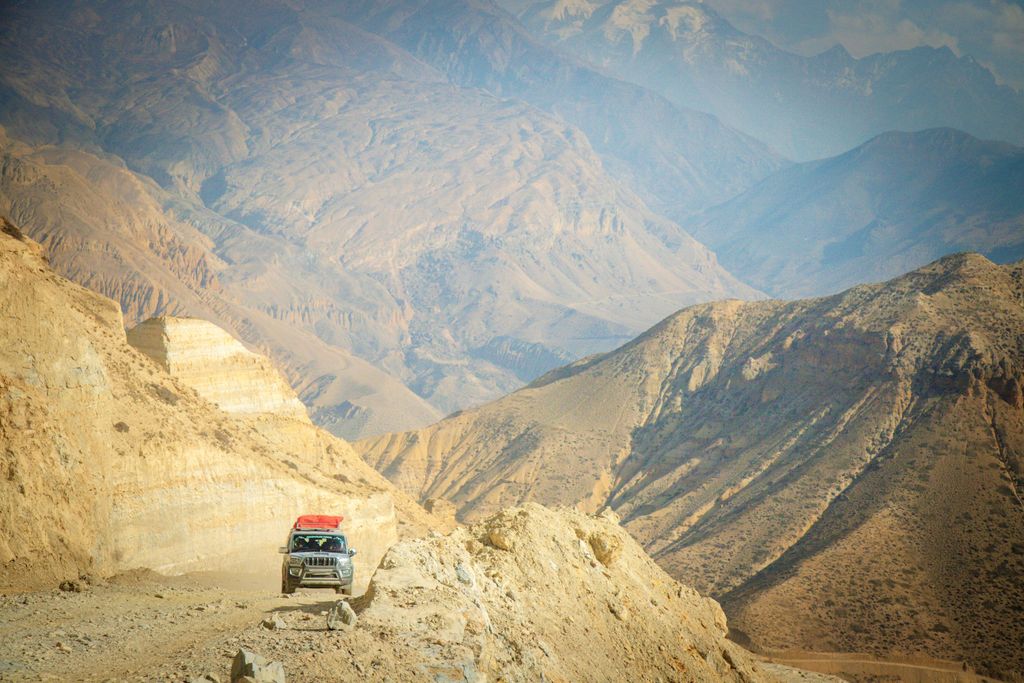
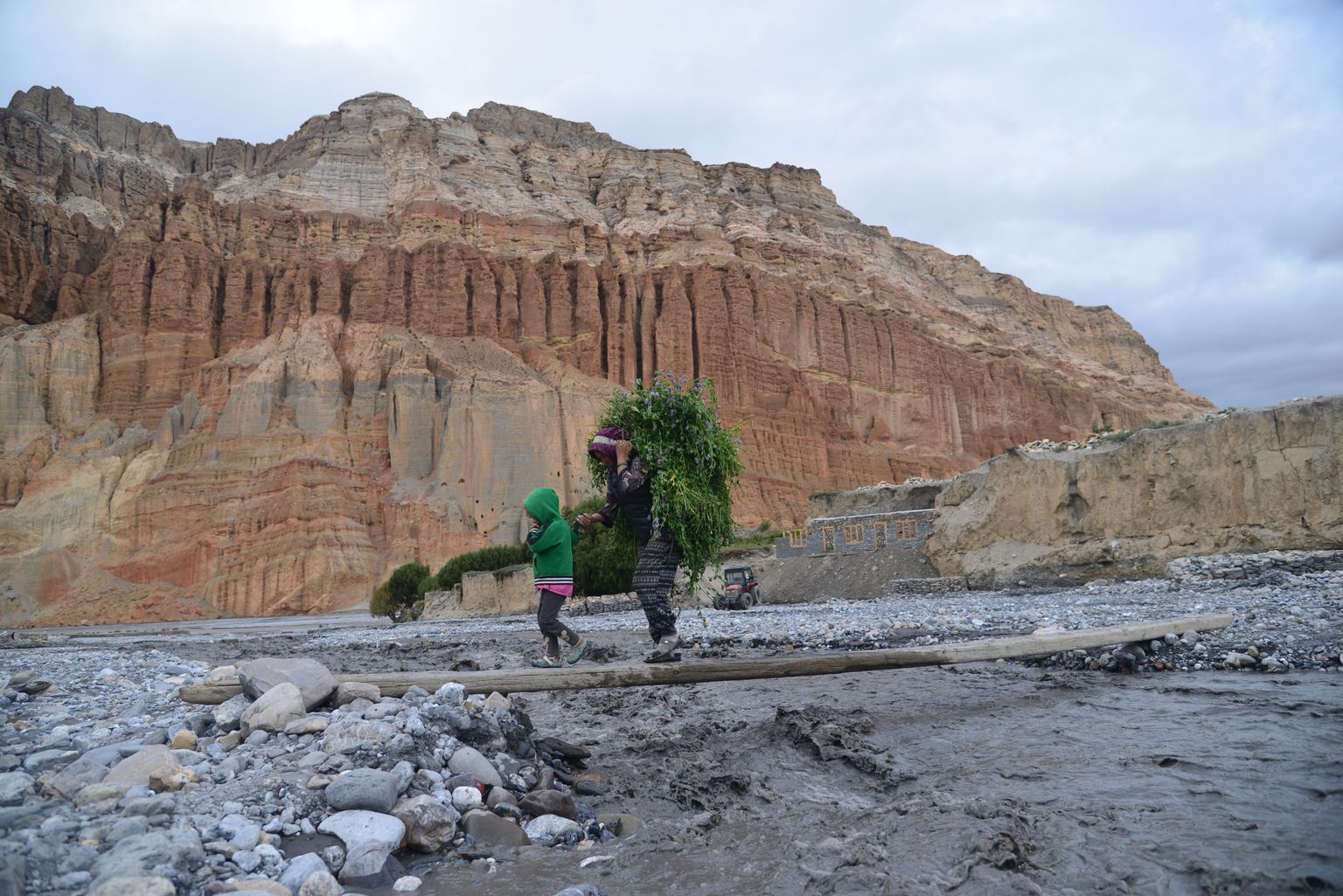
The landscape is radically different from what most people imagine when they hear the word „Nepal”: a plateau at an altitude of 3,500–4,200 metres above sea level, dry canyons in shades of red and ochre, white villages with distinctive architecture, Buddhist monasteries dating back hundreds of years, and Lo Manthang — a walled town, the capital of a former kingdom, which is still inhabited today.
These aren’t the green Himalayas. This is Tibet on this side of the border.
Why is Upper Mustang the best choice during the monsoon?
The key word is rain shadow. The main ridge of the Himalayas blocks the moist air masses flowing in from the south. Upper Mustang lies beyond this ridge — in an area where the monsoon has very little impact.
Specific figures: whilst Pokhara records as much as 1,000–1,200 mm of rainfall per month in July, Upper Mustang receives around 200–300 mm throughout the year. June and July are the best months for hiking here — sunny mornings, breezy afternoons, with temperatures between 10 and 25°C during the day.
In practice, this means that whilst all the classic routes are shrouded in clouds and mud, Upper Mustang is dry, open and accessible.
Formalities – what you need to know before you leave
Upper Mustang is a restricted area. Required documents:
- Restricted Area Permit (RAP) – one of the more expensive permits in Nepal
- ACAP (Annapurna Conservation Area Permit): approx. 30 USD
- TIMS card: approx. 20 USD
Important: A permit for Upper Mustang can only be obtained through a licensed Nepalese trekking agency — it is not possible to purchase one independently. This means that independent trekking without an agency is not possible here. This is important information for anyone planning a solo trip.
The permit covers a specific area and dates — it cannot be extended on the spot, but only in advance by the agency.
The route – what is the Upper Mustang Trek like?
The standard route takes 10–14 days and runs from Jomsom to Lo Manthang and back — or, as an alternative, as a circular route via Ghami and Tsarang.
Starting point: Jomsom (2,720 m above sea level) — accessible by flight from Pokhara (approx. 20 minutes) or by road via the Mustang Highway (6–8 hours, partly tarmac-surfaced road)
Indicative timetable:
Day 1: Jomsom → Kagbeni (2,810 m) — the gateway to Upper Mustang, the last point where no special permit is required. Documents are checked here.
Day 2: Kagbeni → Chele (3,050 m) — the first few hours in a secluded kingdom. The landscape changes dramatically — green fields give way to arid canyons.
Day 3: Chele → Syangboche (3,800 m) — a more challenging day involving an ascent over the Taklam La pass (3,624 m).
Day 4: Syangboche → Ghami (3,520 m) — via Nyi La Pass (4,010 m), white villages, prayer walls.
Day 5: Ghami → Tsarang (3,620 m) — you’ll pass one of the largest monasteries in the region, an old castle and the distinctive architecture of the Lo Valley.
Days 6–7: Tsarang → Lo Manthang (3,840 m) and exploration — a walled town with the Jampa Lhakhang and Thubchen monasteries, the King of Lo’s palace, and narrow streets. A full day’s sightseeing is the minimum required.
Days 8–10: Return to Jomsom (via Chhoser and the Sky Caves, or along the same route)
Landscape and culture – what to expect
Upper Mustang is one of the few places in the world where Tibetan culture has survived in almost unchanged form. Nepal has never fully integrated this part of its territory — Lo Manthang retained its own royal dynasty for a long time (the last king, Jigme Parbal Bista, formally abdicated in 2008 following the abolition of the monarchy in Nepal).
What you’ll see:
- Lo Manthang — one of the few surviving walled towns in the Himalayas, inhabited since the 14th century
- The Sky Caves (Chhoser) — carved into the cliff faces thousands of years ago; some contain mummies and manuscripts
- Sakya monasteries — a Buddhist tradition that differs from that of the rest of Nepal, with its distinctive red, white and black murals
- The Walls of Mani — kilometre-long rows of stones carved with mantras, leading through the villages
- The population of Lo-pa — who speaks a Tibetan dialect and practises traditional farming in extreme conditions
Important note: some sites (monasteries, the palace) charge an additional admission fee. It’s a good idea to carry cash in Nepalese rupees — there are no cash machines.
Climate and conditions on the trail
Upper Mustang is arid, but not an easy trek. Here are a few things that set it apart from a typical trek:
- Wind — that’s the main challenge. The wind blows strongly, particularly in the afternoons, and is very strong along the valleys. It’s best to plan to set off early in the morning, before 8.00.
- Dust — Dry terrain and wind generate large amounts of dust. A face mask or buff is a must-have.
- Sun and UV — At altitudes of 3,500–4,000 metres, UV radiation is intense, particularly when it’s cloudless. Use sun cream with SPF 50+, sunglasses with UV protection and a hat.
- Temperature — 15–25°C during the day; at night, temperatures can drop to 0–5°C, even in summer. You’ll need a sleeping bag and a warm jacket for the evenings.
- Hydration — Dry air dehydrates you more quickly than humid air. Drink more than you think you need.
It’s far more than just Poon Hill or Langtang, but Upper Mustang offers a whole new level of experience — and is one of the few regions where the summer season offers a real advantage rather than a compromise.
Is Upper Mustang a good choice for a first trek?
Yes, with some reservations. The route isn’t technically difficult — it’s a hike, not a climb. However, it does require:
- good physical condition for a multi-day hike with significant elevation gain
- mental resilience in the face of harsher, open terrain without the shelter of the forest
- flexibility — wind, dust and cold nights are part of everyday life, not the exception
- the realisation that this is a different Nepal from the one in the photos of Everest
For someone who is deliberately seeking a contrast in culture and landscape rather than classic Himalayan views, this might be the top choice. For someone who wants to experience „typical Nepal”, it’s better to start with Poon Hill or Langtang.
The most common mistakes
- Arrival without knowing about the rain shadow — someone goes to Upper Mustang simply because it’s raining elsewhere, and is disappointed by the barren landscape devoid of greenery
- Budget underestimation — The permit takes people by surprise if they haven’t checked the formalities in advance
- No cash — There are no more cash machines after Jomsom. You’ll need to carry enough rupees with you for the whole trek
- Underestimating the wind — the afternoon winds are much stronger than on other routes and may make walking difficult
- The schedule is too tight — Flights to Jomsom are prone to weather-related delays; without a buffer, the whole schedule falls apart
FAQ
Is it possible to travel to Upper Mustang independently? No — the permit is available only through a licensed agency, which is responsible for the group. A guide is compulsory.
Is Lo Manthang worth a visit? Absolutely. It’s one of the most extraordinary places in the whole of Nepal — a walled city that has been inhabited for over 600 years, with active monasteries and streets that feel like walking through a living open-air museum.
What is the best month to visit Upper Mustang? Spring, autumn, but also summer—in late spring, summer and early autumn, it will be dry and sunny here, and in summer there are few tourists and prices are lower than in peak season. May and September are good months, but at that time Upper Mustang faces competition from many other open routes.
Is it possible to fly to Jomsom instead of travelling by road? Yes, and it’s definitely worth it. The flight from Pokhara takes about 20 minutes and saves you a few hours’ drive along a mountain road. Flights are sometimes cancelled due to the weather — it’s worth allowing a day’s buffer in Pokhara.
Summary
Upper Mustang isn’t just a Plan B for the monsoon. It’s one of the most extraordinary treks in the whole of Asia — a historical, cultural and scenic experience that’s actually at its best when the rest of Nepal is wet.
If you’re travelling in the summer and want to come back feeling as though you’ve been somewhere truly special — this is the place for you.
Are you planning the Upper Mustang Trek and need help with the paperwork, dates and budget? Get in touch with us — We’ll take care of all the arrangements, including the permits.
