

Climbing your first peak over 6,000 metres above sea level is a completely different experience to trekking. It requires different preparation, different kit, involves different risks and demands a different level of mental resilience. If you’re starting to think about your first 6,000-metre peak in Nepal, this article will help you choose a destination that suits you – rather than one that simply looks best in a photo.
A basic comparison of the three peaks
| Mera Peak | Island Peak | Lobuche East | |
| Height | 6,470 m | 6,165 m | 6,090 m |
| Technical difficulty | low–moderate | moderate | moderate |
| Hardware requirements (simplified) | basic safety measures | basic winter climbing | basic winter climbing |
| The duration of the entire trip | 18–22 days | 18–22 days | 19–23 days |
| Location | Makalu Barun, flight to Lukla (most common) | Khumbu region (EBC) – flight to Lukla | Khumbu region (EBC) – flight to Lukla |
| The peak’s popularity amongst all trekkers | high, but less crowded with trekkers | high | high |
| Suitable for a first trip to the Himalayas | It might be possible, but high-altitude experience is recommended | That’s fine, but high-altitude experience and a basic knowledge of climbing are recommended | That’s fine, but high-altitude experience and a basic knowledge of climbing are recommended |
Mera Peak (6,470 m) – the most sensible first choice if you’re not a climber
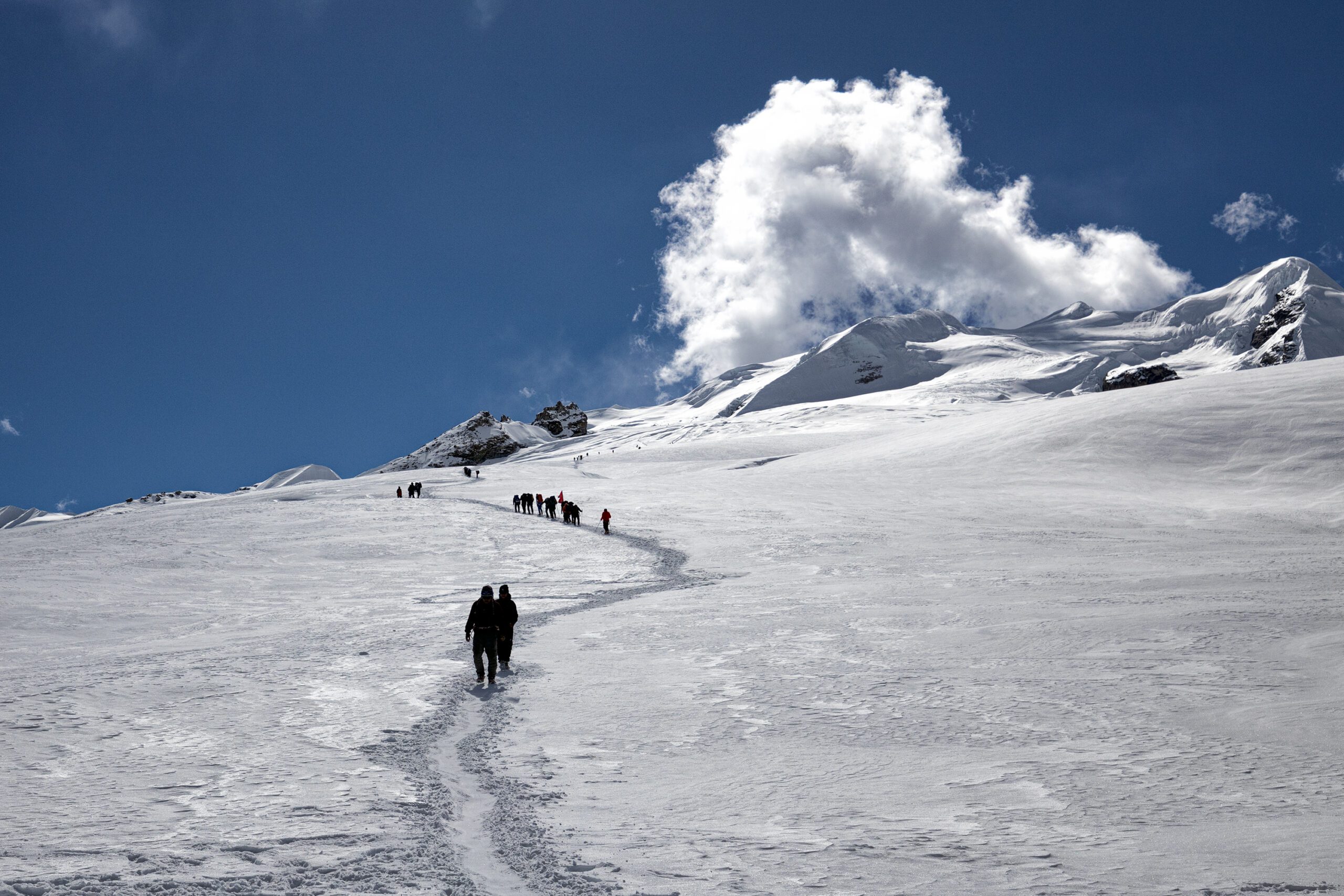
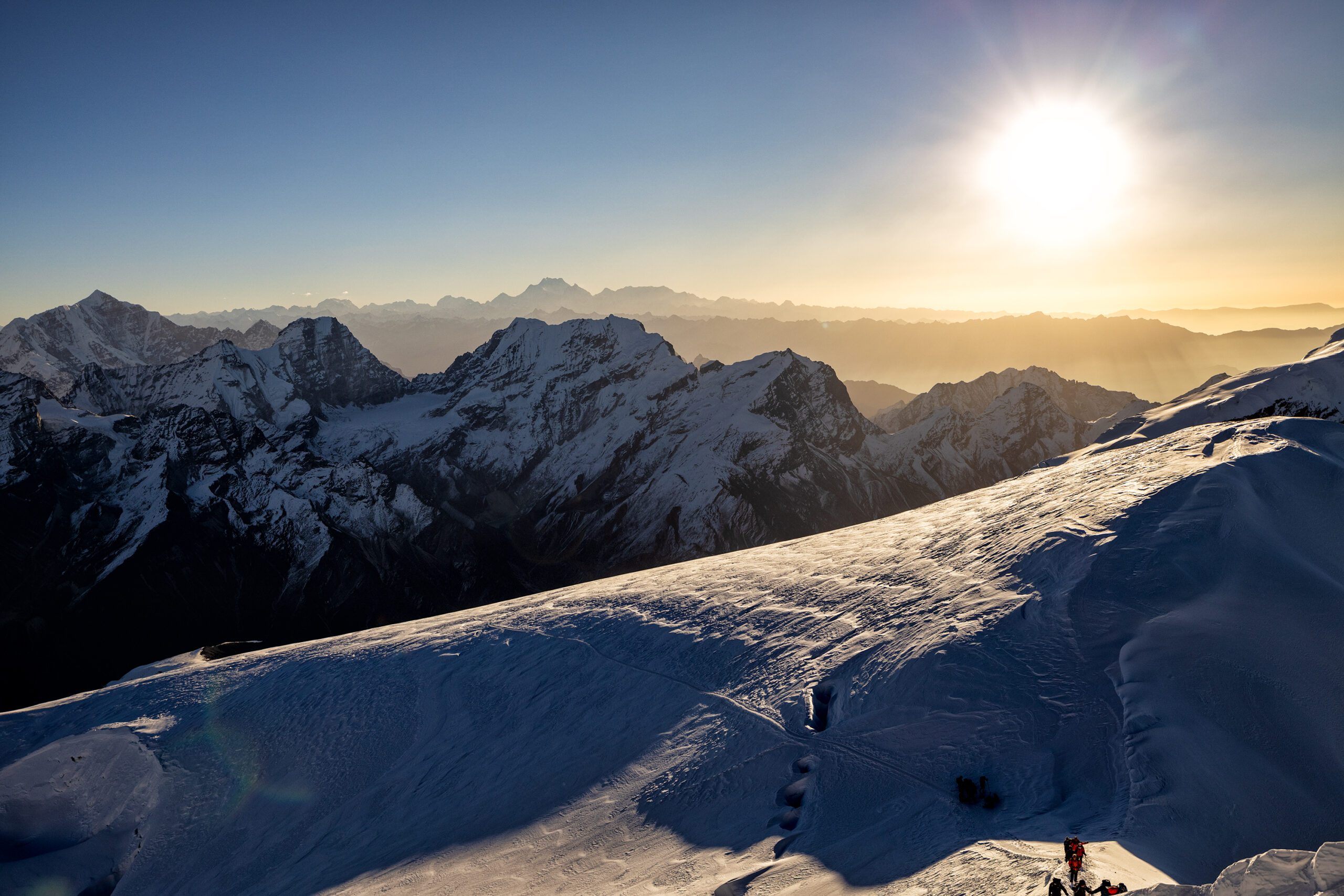
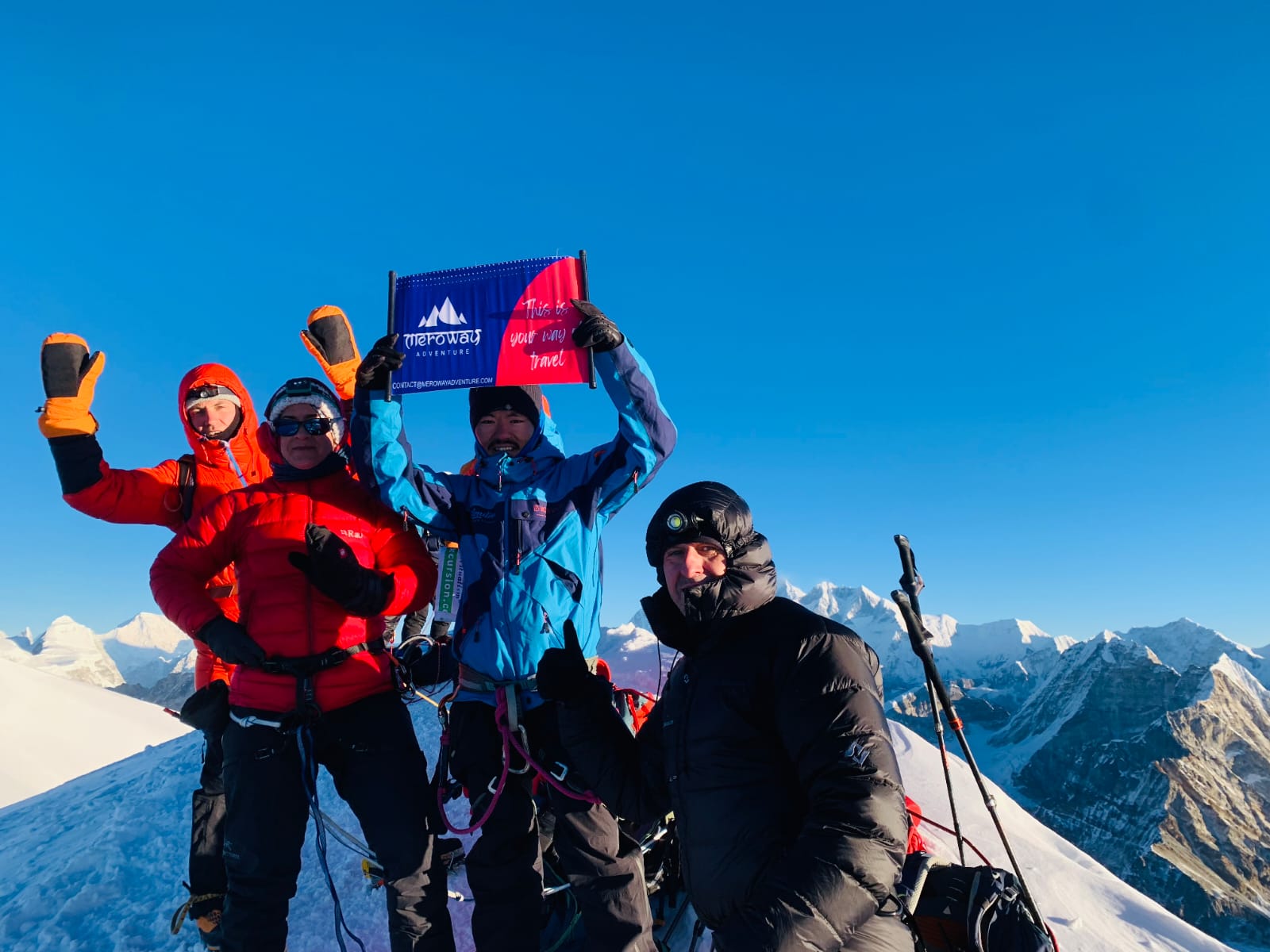
Mera Peak is the highest of the three peaks, but, paradoxically, it is most often recommended for first-time climbers. The reason is simple: the route to the summit is relatively straightforward from a technical point of view — a long ascent across a glacier with no vertical rock faces or narrow ridges. The main challenge lies in the altitude and the length of the expedition itself.
Why Mera Peak is the top choice:
- The summit route consists mainly of a climb across a glacier — it does not require advanced climbing skills
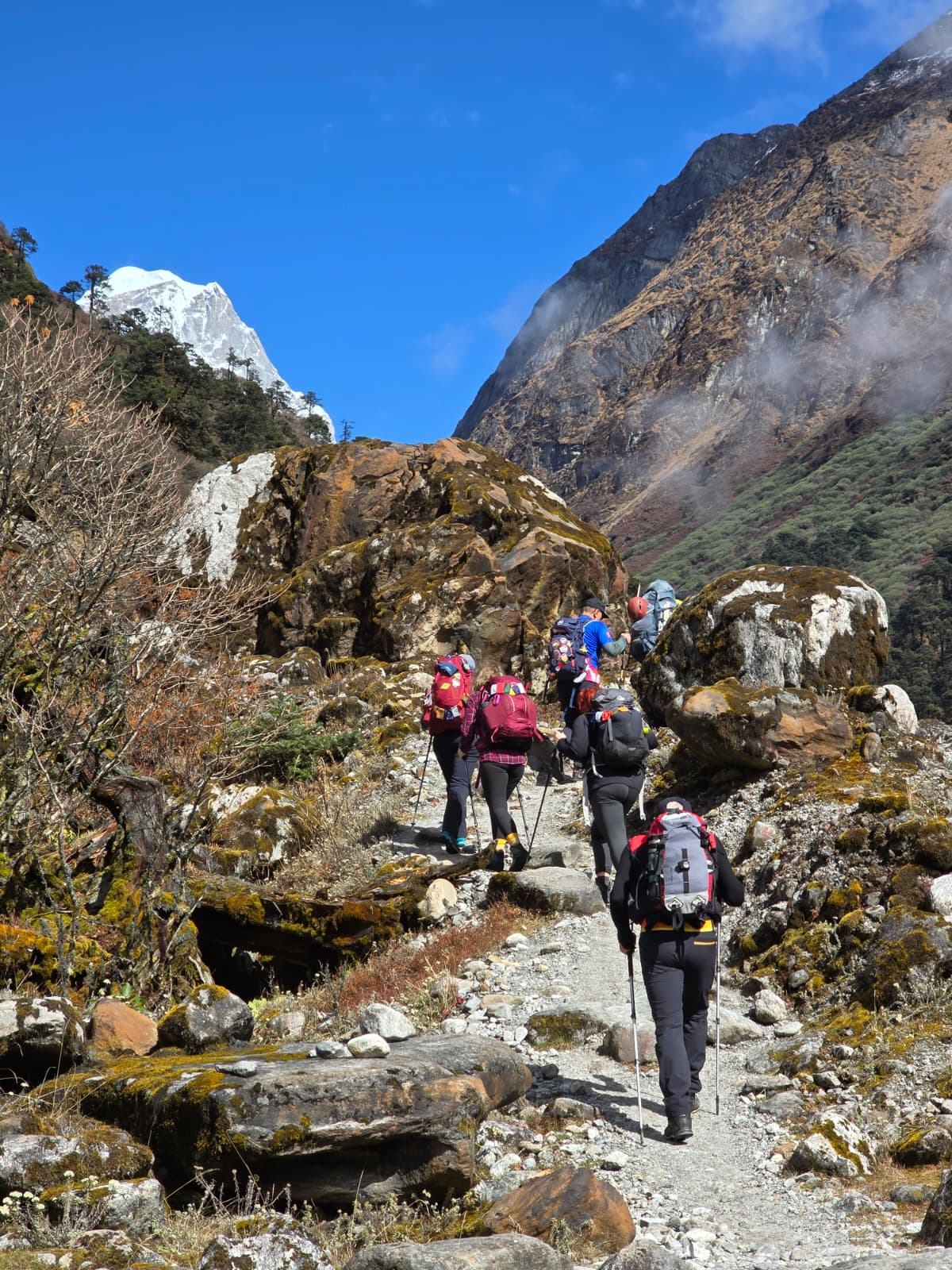
- The route through the Hinku Valley is less busy than the area around the EBC — a more peaceful trip
- For those who are comfortable with heights and are in good physical condition, it is a realistic goal even without any climbing experience
To be fair, the downsides are:
- 6,470 metres is a considerable altitude — altitude sickness is a real risk, particularly if acclimatisation is not managed properly
- The whole trip lasts 18–22 days, which requires holiday leave and a suitable budget
- The glacier requires a basic knowledge of how to use crampons — a course or practical training before departure is compulsory
Island Peak / Imja Tse (6,165 m) – a classic, but not for everyone
Island Peak is situated in the Everest region and is one of the most popular trekking peaks in Nepal. It is often combined with a trek to EBC, which is both an advantage and a pitfall.
What Island Peak has to offer:
- Can be combined with the EBC trek — one trip, two destinations
- The views from the summit are spectacular — the panorama takes in Lhotse, Nuptse and the surrounding peaks
- Good infrastructure
Where Island Peak is more difficult than Mera:
- The summit route includes a technical section — an ice wall (50–60°) with handholds, requiring proficiency in the use of a harness and ascenders – a basic knowledge of climbing is essential; the better you climb, the easier it will be for you
- It is mentally and physically demanding for someone who has never hiked in alpine terrain
- Its huge popularity means key sections get very crowded at the height of the season — you can end up queuing at the wall, wasting time and energy
Island Peak is a good choice if:
- you’ve completed at least one climbing course or have experience climbing on ice; ideally, you simply climb regularly, even if only at a basic level
- You’re in very good physical shape and good health
- You want to combine the summit climb with the EBC trek and you’ve got time for it
- You cope well mentally with being exposed and in confined spaces
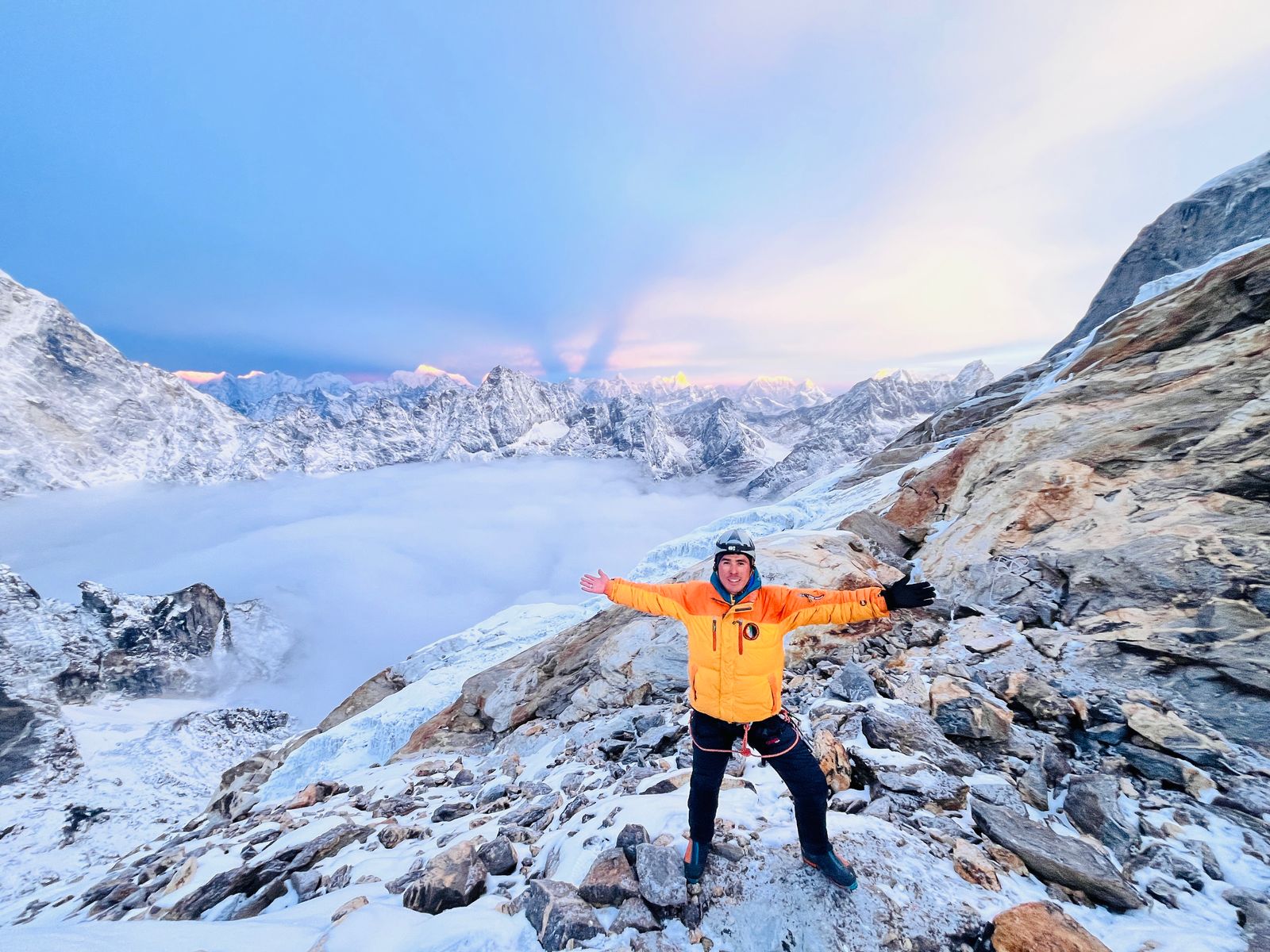
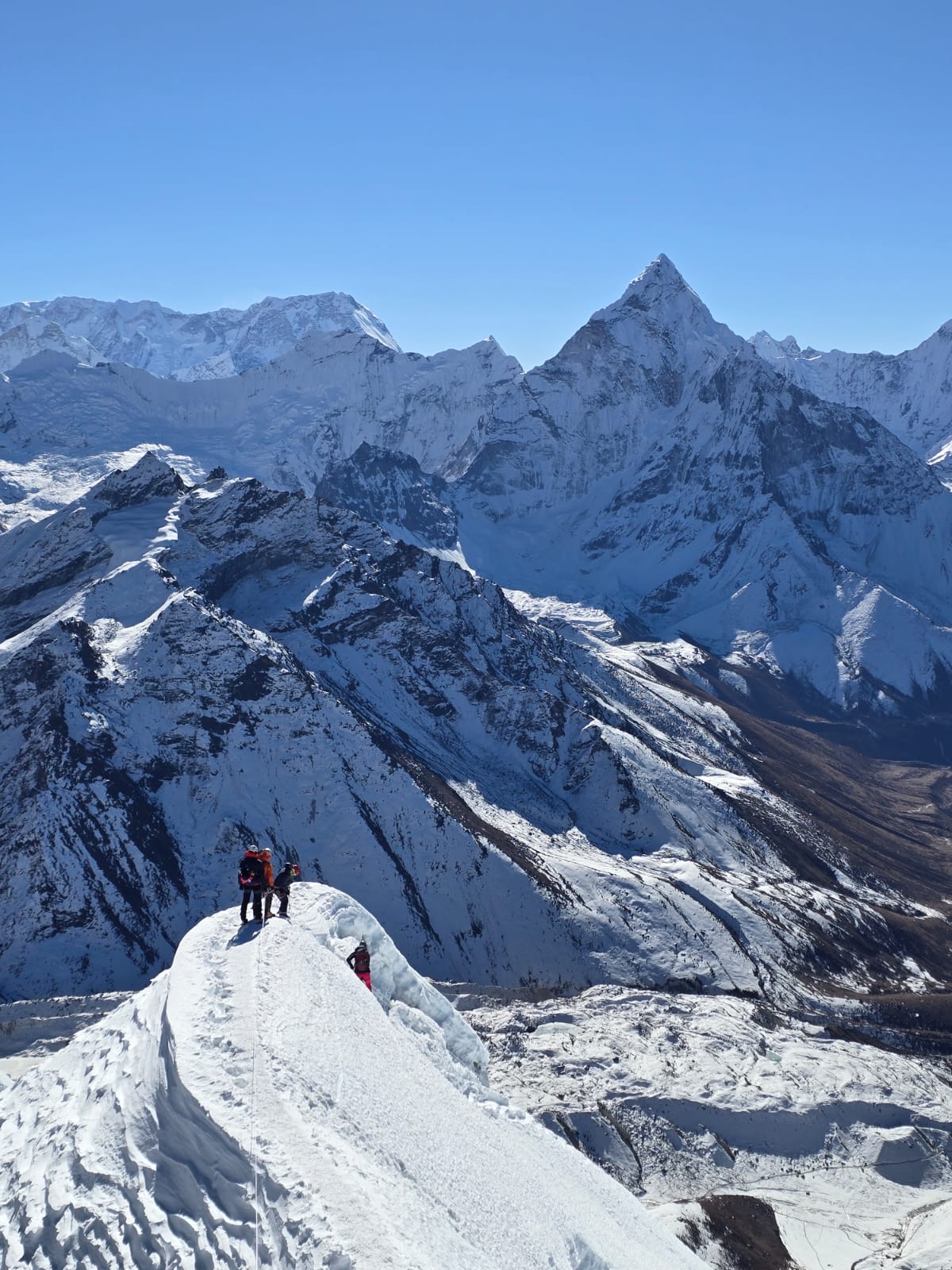
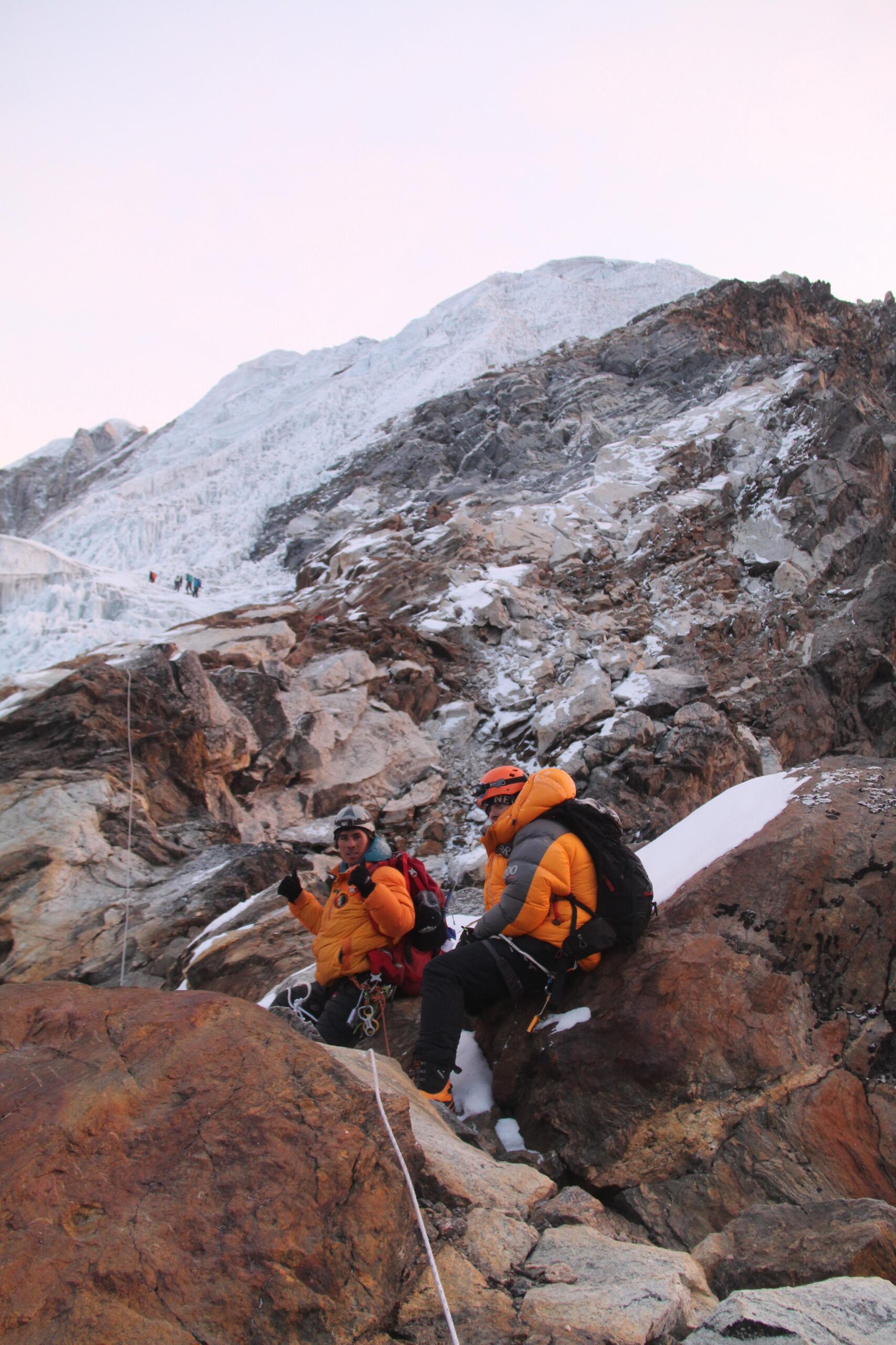
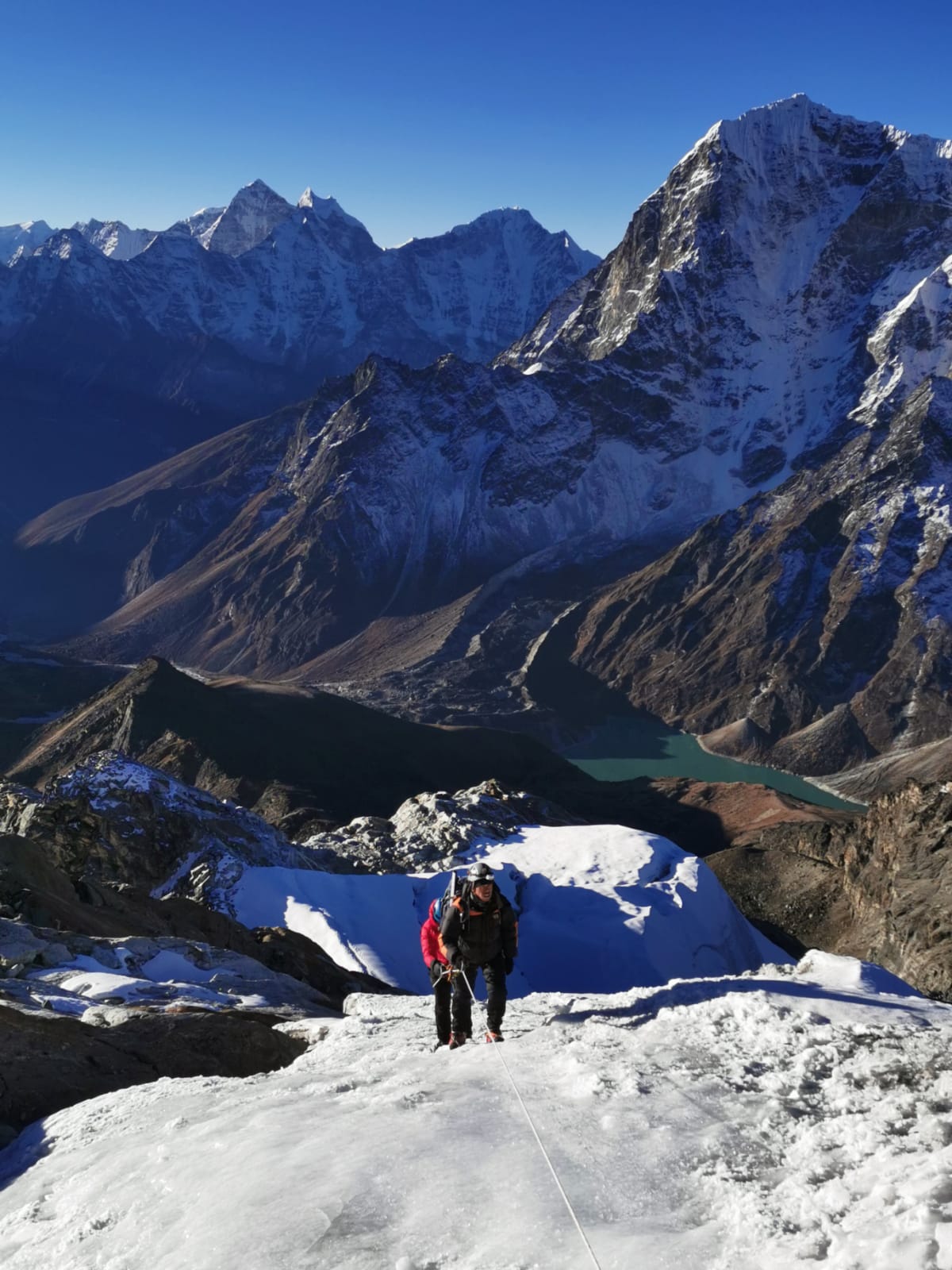
Lobuche East (6,090 m) – an alternative to Island Peak
Lobuche East is situated close to the EBC and is the ideal choice if you want to trek through the stunning Gokyo Lakes and over the Cho La Pass. The summit route leads along a rocky ridge with sections requiring climbing — this is not an easy peak for a first attempt without prior high-altitude experience, although it is, of course, possible as a first Himalayan objective provided you are well prepared.
Who should consider Lobuche:
- people with climbing experience (courses, the Alps or the Tatra Mountains)
- those who want a sportier, more technical experience than the Mera offers
- experienced trekkers looking to take a significant step up, not those new to climbing
Why Lobuche is rarely the right first choice:
- It requires at least a basic knowledge of rock and ice climbing techniques
- A smaller margin of error than on the Mera
- For someone without mountaineering experience, the climb will be difficult
- What you need to have before setting off to climb a 6,000-metre peak
Regardless of which summit you choose, the following items are essential:
Experience:
- At least one or two multi-day treks in Nepal or other mountain ranges above 4,000 metres above sea level are strongly recommended
- an understanding of one’s own reactions to altitude — people who have never been above 4,000 metres face a great deal of uncertainty, although this does not rule them out
- on Island Peak and Lobuche: practical experience with crampons, an ice axe and a harness (basic climbing or mountaineering course)
Condition:
- the ability to undertake multi-day treks of 6–8 hours a day for 2–3 weeks, and the readiness for a demanding mountain operation during the summit push – involving several hours of activity
- strong legs, good aerobic capacity and the ability to recover at high altitude
- in very good health, with no contraindications
Equipment:
- crayfish
- double-layered high-altitude boots – recommended models such as the Scarpa Phantom 6000 or La Sportiva G2 evo, or similar
- ice axe, harness, helmet (Island Peak, Lobuche) – we’ll provide a full list of equipment before the expedition
- sleeping bag rated to at least -20°C, suitable for high-altitude camps
- down jacket, high-altitude gloves – generally suitable clothing providing thermal protection
Some equipment can be hired in Kathmandu, but it’s best to have your own, tried-and-tested boots.
How much does an expedition to a 6,000-metre peak cost?
Approximate budget (excluding flights from Poland):
| Category | Approximate cost |
| Summit permit (Mera/Island/Lobuche) | 250–400 USD |
| Guide + porter | US$600–900 (18–22 days) |
| Accommodation and food along the route | US$400–600 |
| Kathmandu–Lukla flight (return) | USD 360–440 |
| Equipment (purchase or hire) | USD 200–600 |
| Insurance covering helicopter rescue | 150–200 EUR |
| Buffer | 200–300 USD |
| In total | approx. 2,000–3,500 USD |
It’s much more than a standard trek — and it’s a fair price to pay for an ascent to a peak over 6,000 metres with a guide and the necessary safety equipment.
The most common mistakes when choosing your first six-thousander
- Choose based on height or prestige, not on fit — 6,470 metres on Merze does not automatically mean it is more difficult than 6,165 metres on Island Peak. The nature of the route is more important than the figure itself
- Lack of experience with heights — People who have never been above 4,000 metres are heading into the unknown. It’s worth testing yourself first on Poon Hill, Mardi Himal or Langtang, or on another mountain outside Nepal – for example, on a high-altitude trek, or ideally on ascents of peaks such as Ararat, Kazbek, Mont Blanc or Kilimanjaro.
- Overestimating the impact of physical fitness — Even excellent physical fitness is no substitute for technical skills on Island Peak and Lobuche, nor is it a substitute for proper acclimatisation
- Treating a 6,000-metre peak as a long trek — it’s a different kind of trip, with different risks, different kit and a different mindset; trekking is part of the expedition, but the actual activity on the mountain is governed by different rules and presents different challenges
- Ignoring the psychological profile — The exposed terrain, the darkness during summit ascents (which often start at 1 or 2 in the morning), fatigue and the cold affect people very differently. It’s worth being honest with yourself about whether you’re up to such a challenge.
Decision filter – which peak to choose?
Mera Peak, if:
- This is your first experience of high-altitude climbing / your first high peak
- you have already completed a trek to an altitude of 4,000–5,000 metres or an expedition to another high-altitude peak, including those outside Nepal, and you know that you cope well with the altitude
- Do you want to reach a summit over 6,000 metres without needing advanced technical skills and without any elements of traditional climbing?
Island Peak, if:
- you have basic climbing skills and aren’t afraid of technical ice terrain
- Do you want to combine the summit climb with the EBC trek?
- You cope well with exposure and confined spaces when you’re tired
Lobuche East, if:
- you have experience of climbing in the Alps or the Tatra Mountains and are looking for a real climbing challenge
- This isn’t your first time tackling technical climbs
- Do you want to combine a summit climb with a visit to the stunning Gokyo region and a trek across a high-altitude pass?
FAQ
Is it possible to climb a 6,000-metre peak without a climbing course?
Mera Peak — yes, provided you’re fit, well-prepared and have the right support on the ground. Island Peak and Lobuche — this isn’t a good idea without a basic course and experience in glacial terrain.
How long does acclimatisation take before reaching the summit?
The expedition plan allows for a gradual ascent — you do not attempt the summit immediately upon arrival. Typically, it takes 10–14 days of walking and acclimatisation before attempting the summit; this obviously depends on the peak, but proper acclimatisation is extremely important and has a significant impact on the potential success of the ascent.
Which season is the best?
March–May and October–November. The peak season offers the best weather conditions on the glaciers, but also means there are more expeditions on the routes.
Is it possible to withdraw partway through without any consequences?
Turning back is always an option and a wise decision when the body sends out warning signals or when external circumstances make it necessary. The permit is non-refundable, but health comes first. Good agencies do not put pressure on participants to continue the expedition when AMS symptoms are present; moreover, reputable agencies organise expeditions with the participant’s safety as their top priority.
Summary
Climbing your first six-thousander is one of those moments in the mountains you never forget. For it to be the best possible memory, it must be a logical step — not an impulse.
For most people, Mera Peak is the most sensible stepping stone between trekking and the world of summiting. Island Peak and Lobuche Peak offer more of a technical challenge, but require appropriate technical support.
Have you decided which peak you’re interested in yet? Get in touch with us — We’ll help you assess your level of preparation and draw up a realistic, step-by-step plan.
